Showing posts with label Joseph Schneider Haus. Show all posts

Thursday, 2 October 2014

Heart & Hand: People's Choice!


Thank you to all the artisans, wonderful guests, volunteers and staff (not to mention the beautiful weather we had) for another successful Heart & Hand Festival.

We encouraged you to vote for your favourite artisan display and you did!

Pysanky Artist - Anne Cline
Anne is a perennial favourite at the Heart & Hand Festival and we were so happy to have her back again this year. With her array of intricately decorated and detailed eggs she impressed visitors of all ages. She also gave people a chance to try the wax relief dying technique for themselves. Congratulations Anne on you People's Choice win!


Potter - Lisa Marcus
This was Lisa's first time at the Heart & Hand Festival and she made a big impression. Along with her display of whimsically decorated pottery Lisa brought a potter's wheel and invited visitors to try for themselves. She also taught visitors some clay hand building techniques. She surely inspired some new potters! Congratulations!


Fibre artist,Wendo Van Essen, performer and multi-talented 2013 Folk Artist-in-Residence, Sarah Granskou, along with Cabinet and violin maker, Phil Elsworthywere also among the top favourites at this year's Heart & Hand Festival.

See you next year!


Thursday, 25 September 2014

Heart & Hand: Tell Your Story

A special feature of the Heart & Hand Festival are the wonderful stories and musical performances presented by our guest storytellers and entertainers. 

Do you have a story to tell? Since Heart & Hand is a participatory event we’re inviting folks to bring a story. Put your name in the hat for a chance at the mic!

Here are the rules: Your story must be true, and it must be short. Two minutes is the maximum and there will be timers. And perhaps a gong, or a hook, but most certainly loads of fun for all. 
Polish up your best anecdote, time it, and come along to the music and storytelling tent at the Heart & Hand Festival.

Schedule of Events

10:30 a.m.     Drum Circle 
                       Nii Addico 

11 a.m.           Musical Performance
                       Sarah Granskou (with Amy Scott)

Noon              Baden Storytellers
                     Derek Brisland
                     Debbie Jones
                       Mary McCullum Baldasaro

1 p.m.             Musical Performance
                     Ian Bell                       

2 p.m.          Baden Storytellers
                   Gail Fricker
                   Stephen Van Vugt
                    Carolyn Wilker

3 p.m.          Drum Circle
                   Nii Addico


Wednesday, 24 September 2014

Heart & Hand: Blogger and Food Historian, Carolyn Blackstock

Meet Carolyn Blackstock, local food historian, 
blogger and teacher interpreter with the Waterloo Region Museum.            
           
Two years ago Carolyn blogged about her adventures using the 1912 Berlin Cook Book, making a recipe every day for a year. She's at it again, using another local cook book, this time from Cambridge, ON, the 1898 New Galt Cook Book. In her daily blog, Cooking with the Galt Cook Book , Carolyn not only explores the historic recipes but she also researches the lives of the people who contributed them. We asked Carolyn about her interest in historical recipes and her take on changing food traditions.

              How were you first introduced to heritage recipes and what keeps you interested in taking on these projects?
I was first introduced to heritage recipes while working at Doon Heritage Crossroads (now Doon HeritageVillage) and exploring life in 1914 in a rural Waterloo County village. Cooking in the Seibert house was similar to my own upbringing in rural Southern Ontario, so the cookies and canning I did in that building were familiar. It was when I started working in the Martin House, the Old Order Mennonite home, that I was really challenged to understand the food of this era and culture. It required some research and experimenting and I loved it. 
One of  the great aspects of working with historic recipes is that usually the experiments are edible even if they fail. I love the challenge of figuring out the recipe, finding the ingredients and then seeing how it fits into the history. I especially like finding great old recipes that are new to people today. The two projects I've been working on over the past three years involved an extra part. Since both the Berlin Cook Book of 1912 and The New Galt Cook Book of 1898 are community cookbooks, the names of the women (and a few men) who shared their recipes are listed. I love trying to find out more about these people and thinking about how these recipes fit their lives.

           
How does researching the history of a recipe compare to researching an artifact, like a spinning wheel or quilt?
Researching an artifact is amazing, but there is something special about researching a recipe. It is possible to learn more about a recipe without making it just as you can research a quilt or spinning wheel without using it. But a recipe can be used without causing any damage to it and I think trying the recipe provides even more information. It is a form of material culture and living history. It is impossible to recreate it in a totally accurate way, but it is possible to come close with ingredients and methods. This can give a lot of insight into the lives of people who might have used such a recipe.

            Do you think our relationship with food has changed since the late 1800s?
We all still eat, but what we eat and how connected we are to the source of our food has changed. I’m often asked about the kinds of flour and sugar used in these recipes, but the areas that have changed significantly are more likely to be connected to animals. Egg production has changed dramatically and the processing of dairy products is quite different. We are more distant from the meat and poultry we eat. Meat and poultry are purchased in a more packaged form. The poultry recipes in particular often include directions for dressing the bird and meat recipes talk about requesting the butcher to cut the meat in a specific way. Another surprising thing is that we have more information about our food. Our food comes in packages with ingredients listed. The writers of these cookbooks had grown up in a time when food adulteration was a major concern. There is an interest today in where our food originates, which I don’t think was an issue in the late 1800s.

             What will your next big project be? Do you have a recipe or meal you want to try but haven’t yet?
I would like to do more with The Berlin and Galt Cook Books – to publish annotated editions with information about the recipes and contributors for example, but I don’t have another project in mind. I am interested in experimenting with recipes from a much earlier time too. I have cooked some recipes from the 1600s, but I would like to try some medieval or even ancient Roman recipes. And then there are other Canadian cook books to try. 

Carolyn will be on site, recreating a traditional recipe at the Joseph Schneider Haus on Sept. 27 as part of the annual Heart & Hand Festival.  Admission is free.

Photos by Candice Leyland.

Thursday, 18 September 2014

Heart & Hand: Potter, Lisa Marcus

We are very excited to have Lisa Marcus from Mermaid Springs Pottery in Kitchener join us this year for the Heart & Hand Festival! Lisa has been working as a potter for more than 23 years, and like the Schneider family, Lisa moved to this area from Pennsylvania! 

Most of Lisa's work is thrown on the potter's wheel but she also does hand building to create the characters and figures that adorn her pieces. These decorative elements are inspired by her interest in ancient cultures, Goddess worship and her passion for cats. All her designs are original and produced by Lisa herself. These beautifully decorated and whimsically fun pieces are meant to bring a little bit of excitement and joy to your every day or special occasion. 

Interested in learning how to make some unique pieces of your own? You are in luck! Lisa teaches wheel classes form her Kitchener studio twice a week! 

Stop by the Heart & Hand festival on Sept. 27 to visit Lisa and all our wonderful artisans!


Thursday, 11 September 2014

Heart & Hand: Spinning Wheel Restoration with Reed Needles

Spinning wheel restorer Reed Needles answers a few questions about his craft and gives us some tips on what to do with that antique spinning wheel you find at the flea market!
Reed will be at the Heart & Hand Festival Sept. 27 with a variety of spinning wheels. Come by with your questions and say hello!

How did you get started repairing spinning wheels and what keeps you interested in the craft?
      I have always been interested in colonial and pioneer crafts, and experimented with a number of areas and articles over the years. In my teens I worked with a barn-framer, learning to build timber and log buildings. As I learned more, I took up carving and cabinet-work. I was also fascinated by machinery, especially mechanical clocks and watches. For the last 20 years or more, I have concentrated more and more on lathing. It was that skill that brought me my first wheel – a flax wheel from the late 1700s given to me by my sister-in-law. Having successfully repaired one wheel, it wasn’t long before more members of her guilds sent me their wheels. Each wheel taught me something new about the craft, and about the variety of skills involved in building wheels. 

      Now, some seven years later, I have repaired about a hundred wheels, and have a stock collection which (try as I might) never seems to be less than 30. I’m one of about three people in Ontario who do this on a regular basis. The irony is that I’m not a particularly good spinner. I know enough to be dangerous or, more accurately, to know when a wheel is working properly, or what needs to be done to make it work properly. 
      
      I’m continually amazed by the depth and variety of skills that old wheelwrights possessed. They weren’t just technicians, but artisans – capable of producing remarkably attractive and functioning articles, that were both useful and visually appealing at the same time. 
    
      What makes a wheel worth repairing? 
Not every old wheel can or should be restored. There are a number of considerations in deciding whether a wheel is worth repairing.
    
First, it has to be of some value, perhaps 
 because it was built (and signed!) by a known maker, represents an unusual or particularly fine example of a certain type of wheel, or is simply built well enough to be of some future service. However, it might be so old, or unusual that it should only be conserved, and not refurbished. (Some museum pieces for example, should never be altered, refinished, heavily cleaned or re-built. To do so 
would destroy their heritage and historic value). 

Next, it has to be practical to rebuild. There are no spare or after-market parts available for old wheels. They have to be made – usually by hand and usually by eye. And repairs frequently cost little in material, but a significant amount of time – and that cost is passed along to the customer. So - a vintage wheel that cost perhaps a hundred dollars at a flea market or lawn sale might involve two or three times that much in repair – especially if important pieces are missing and have to be built from scratch. If you’re not careful, you may well end up with a wheel that cost more to repair that it’s worth on the open market. Another question – will it work well enough when finished to justify the repair? Not every old/antique/vintage wheel was perfectly designed or flawless in operation. 

Finally – is the wheel matched to the spinner? Many experienced spinners will tell you that there are very few, if any, antique wheels that were originally designed to be used by a novice. For example, the Canadian Production Wheels from Quebec that were built for very experienced spinners, often prove frustrating for a novice spinner, since they were designed to be used by women (and men) who had spent their lives mastering the craft.

      Why repair old wheels when there are modern wheels available? 
      Many modern wheels by makers such as Lendrum, Louet, Ashford, Majacraft, Kromski and others, are beautifully designed, flexible in use, portable and sturdily built (with warranties!!). For a new spinner especially, these are the wheel of choice, since they can “grow” with the user. Older wheels do but one thing – and usually very fast. However, old wheels have that indefinable something that makes them both visually and historically appealing. They may perhaps be a family heirloom, or from a known maker, or just so obviously old that they convey a sense of the time and a faint aura of the people that used them, so that owning and using them connects the user to the past.

      New wheels are surprisingly more expensive (sometimes much more expensive) than antiques. A new Kromski or Majacraft wheel will cost at least $500, and over $2000 if you pick one of the fancier or custom-made models. You can pick up a good vintage wheel in working condition for sometimes less than $100 – so there’s a price advantage in rescuing an older wheel. Mostly however, I think people choose an older wheel for its aesthetic value, and the joy of seeing something so old still produce useful and beautiful fibre.

How can you tell when and where a wheel was made? 
Dating a wheel and uncovering its provenance is a daunting task – and requires a lot of experience in observing, handling and using wheels. Sometimes it’s relatively easy – the wheel is signed and dated by either the maker or the owner. (Frank Young wheels came from Nova Scotia in the mid-1800’s).  Sometimes the style is unique to a certain area and a certain era. (Small, narrow-based and steeply-angled Saxony flax wheels are known as “slantys”  and are frequently of Baltic origin, even though they show up in Minnesota or Wisconsin.) Sometimes, we know from historical research that certain designs of wheels were used in certain areas at certain times and for how long, (flat rim Acadian wheels were in use in Eastern Canada from the late 1700s up to the mid 1800s) which helps to identify a wheel and its provenance.

On older wheels especially, types of wood used, tool marks and design features, including tensioning and drive systems, give a clue as to its age or origin. (Indian Head spinners from the West Coast were built to be mounted on a Singer sewing machine treadle base – and folded into the table exactly the same as the machine did). Frequently, no matter who made them or where, we can tell how long they were used by observing the wear on various parts of the wheel, especially the treadle. I have a lovely old flax wheel in my collection where the treadle bar has worn completely through the leg down to the floor, at which point the owner had the leg turned and a new hole bored to take the pin on the end of the treadle – twice!!

As to their makers and users, apart from some extraordinarily beautiful turnings and wood choices, by and large these were wheels that were made to work – hard and long. North America did not seem to produce very many of the light, elegant and very decorative “parlour wheels” that were part of middle and upper-class European society. North American wheels are sturdy, workmanlike and practical in design and construction, since they were a vital part of the working life in most early settlers’ homes. And judging by the condition in which we find some of them now – they were used until they quite literally fell apart!

Is there a particular wheel you would love to work on or a project you are excited about? 
I’m always excited about working on a type of wheel that I have never encountered before. Every once in a while an unusual wheel comes along that needs some study before it can be put back into working order. I love seeing and reproducing really intricate or beautiful turnings, I enjoy using antique tools to reproduce a part in exactly the same way that it was made originally (some parts on a wheel cannot be machine made – only by hand, and only using the original tools) and I love seeing a well-made wheel brought back to life with some love and attention. The best part, however, is seeing how much delight it brings the owner when a dusty, broken and shabby wheel suddenly re-appears, clean, working and complete – ready for them to use and enjoy for a long time to come.

What are your top 10 tips for people looking to restore or repair their antique spinning wheel?
This is not a complete list by any means, but the following points might help in choosing and caring for a wheel, and whether or not they might want to have it restored:


1.       Make sure it’s a real wheel, and not a decorator item – as a number of wheels made in the 1970s and 80s were. This is one of the most frequent problems I encounter, and it always saddens me when I have to tell someone. Make sure all the parts move and adjust the way they should. A typical fake will not allow you to move the flyer and bobbin arrangement (known as the “Mother of All”) towards and away from the drive wheel. Make sure you can actually put a piece of wool through the iron spindle and onto the flyer hooks. Make sure the hooks are made of wire, not cup-hooks (another hallmark of a fake wheel).  In general, even though it might look like a wheel (and turn like one), if you have any doubts, make sure that it spins. If you can’t spin, find someone who can. Not every dealer/seller knows when a wheel is real – and fakes can be expensive!

2.      Make sure ALL the parts are there – novices often buy incomplete wheels because they don’t know what should be there, or they were told that a missing part wasn’t needed. There are very few non-essential parts on a wheel. Look at some pictures, learn to identify common types of wheels (Saxony, upright, castle, frame) and make sure you can identify every part before you buy it. (Missing flyers for example can cost $150-$200 to replace, if you can find someone to make it for you – and no – the parts on old wheels often cannot be interchanged.)

3.       If you own a solid working antique, take care of it. Don’t leave it in a sunny window or close to an indoor heat source. Solid wood, even though it’s over a hundred years old, will still warp, shrink and crack. Oil your wheel lightly, make a dust-cover for it, and try not to move it around too much. The old wheels were designed to stay in one place – not be packed into the van for spinning evenings twice a month. Take your modern, fully-seasoned and finished factory wheel on the road with you. Leave the antique at home.

4.      Don’t expect an old wheel to work perfectly all the time. In their heyday, they were still cranky and prone to odd moments of bad behaviour (humidity, wear, lack of oil or adjustment). Don’t put it to production use – you’re a curator/custodian of an antique. Future generations will thank you for treating it gently.

5.      Don’t refinish it!! Removing an original finish destroys any antique’s value. A refinished wheel is worth far less than one with original finish – especially since some of the finish might include clues as to the wheel’s origin.

6.      Many wheels have had repairs done to them at various points in their history – and those repairs are part of their history. Removing, altering or otherwise “cleaning up” a repair can be as bad as refinishing. If it does need repair, have a professional restorer look at it. (Robertson screws may work well, but they are an eyesore on any wheel made before 1990!) Removing old wire, nails or leather may make it look more respectable, but only if the ensuing repair is either invisible or period appropriate.

7.     Don’t be surprised if an old wheel only produces one kind of single, or doesn’t like to ply. Many wheels were originally made for flax, and some conversions were made to make them spin wool as singles. Most wheels were used for singles, since that was the fibre that went into weaving cloth. Some old wheels can ply wool for knitting, but not all. You have to learn what your old wheel was made for, and can produce, and be patient. And many old wheels are very fast, aggressive spinners, due to their high ratios – which produce very hard fine singles. Your old wheel may not spin the kind of fibre you want.

8.      Use multiple bobbins on new wheels only. Multiple bobbins make spinning faster, since you don’t have to wind off the single on the bobbin before starting a new one. New multiple bobbins can be made for old wheels, if you get the dimensions absolutely identical.  However, taking apart the flyer and whorl to change bobbins often leads to damage (dropping a flyer can break the arms, dropping a bobbin or whorl will chip the rims). Try to leave the flyer intact, and wind off from the bobbin while it’s still on the wheel. Everything will last longer as a result.

9.      Don’t try to disassemble a wheel that doesn’t want to come apart easily. It may seem like a good idea to disassemble a wheel for transport, but often previous owners have fastened legs, uprights, maidens etc. permanently (sometimes using hardware or modern glues) and trying to take such a joint apart usually shatters it. Transport them as little as possible, and then with as much care as you can.

10.  Finally – be careful when buying old wheels, since many are beyond repair, or too expensive to restore. Do some research to find out as much as you can about the wheel(s) you are interested in, take along a knowledgeable companion who can help you spot problems, and don’t believe everything you hear from a seller. Buy from someone who spins, whenever possible, since only a spinner will be able to tell you how well this wheel works. And beware! – collecting wheels can become compulsive. Enthusiasts call it “falling down the rabbit hole”. One wheel never seems to be enough. Sigh…

Happy spinning!


All photos by Candice Leyland, volunteer and Friend of Joseph Schneider Haus. 

Tuesday, 2 September 2014

Heart & Hand 2014: FAIR Sue Firkser


Meet Sue Firkser, 2014 Folk Artist-in-Residence at Joseph Schneider Haus. Sue discovered felting about six years ago and fell instantly in love! 
She has always been a painter, in various mediums, but enjoys using felt as a means to express herself in a painterly way. Sue uses colour (wool roving) and line (silk) to lead the viewer through her artwork and although the pieces have a fragile appearance, they are in fact quite strong due to the blending of the fibres during the felting process. Wool is one of the oldest and strongest fibres known to man.
Sue’s training in environmental design gave her the chance to explore commercial fabric and upholstery design and in later years contributed to a successful business of the surface design and production of a line of flannel pajamas. 
More recently she has begun to play with felt and fibres to create functional clothing, hollow form sculpture and decorative arts for the home. Sue enjoys pushing the boundaries of this ancient craft. 
Sue will be demonstrating wet felting at the Heart & Hand Festival this year. Drop by and say hello! 
Demonstrations
Saturday, Sept. 27 -
 Wet Felting  at the Heart & Hand Festival
Workshops
Saturday, Sept. 20 - Painting in Fibre II
 - 10 a.m. to 4 p.m
Full-day workshop - $158, taxes and materials included
Saturday, Oct. 25 - Cozy up Making Hats or Mitts - 10 a.m. to 4 p.m.
Full-day workshop - $158, taxes and materials included
Saturday, Nov. 8 & Sunday, Nov. 9 - Felted Fashion:Make a Felted Jacket
- 10 a.m. to 4 p.m. Two-day advanced workshop - $300, taxes and materials included

Saturday, Dec. 6 – Christmas Stockings in Felt
1 to 4 p.m. (half-day workshop)
$75, taxes and materials included.

Wednesday, 9 July 2014

Heart & Hand 2014: Artistans

We're getting geared up for another great event this Sept. 27. 

If you, or someone you know, is a traditional artisan eager to take part in this event get in touch with us.

Is there something you would like to see at the festival? Let us know and we will try and make it happen!

Did you have a great time last year? Share your memories and photos.

Contact jsh@regionofwaterloo.ca or call 519-742-7752
Follow us @jschneiderhaus or @hearthandfest


Thursday, 10 October 2013

Heart & Hand: The Winners Are...!

Thanks to all of our talented artisans and storytellers, wonderful volunteers and of course... all our enthusiastic visitors who made Heart & Hand 2013 a great success!

Our Best of Show winner as chosen by our panel of judges was wood worker and former Folk Artist-in-Residence Peter Findlay.


Our People's Choice winner was Naomi Smith, First Nations artist and educator. This was Naomi's first time being part of the Heart and Hand festival.

Prizes were generously donated to the winners by Roya LePage Scharf Realty Limited.

We will see you in 2014!


Saturday, 21 September 2013

Heart & Hand: Rain or Shine!

When was the last time you played in the rain? ...and then dried off by an open hearth or a wood stove? Today is your chance! The Heart & Hand Festival starts today at 10 a.m. lots to do and see, inside and out! Find that perfect treasure and see traditional artisans at work!

Our assistant curator Antoinette is ready for the weather. Lets see your rain gear fashion! Tweet us @hearthandfest!

Friday, 20 September 2013

Heart & Hand: A visit to the Papertrail with Kevin Martin and Audrey Hollinger

Photo by Candice Leyland
Join Kevin, Audrey (and their resident cricket) for a tour of their New Dundee shop, The Papertrail. They do it all from paper making, to printing and... paper marbling! They will be demonstrating this traditional art form TOMORROW at the Heart & Hand Festival!

Photo by Candice Leyland


Come by and say hello, take part in a demo and pick up some one of kind marbled or hand made paper for your next project!

Want to visit the studio in person? The Papertrail will be taking part in the Rural Routes Studio Tour Nov 1 & 2.  Check out the Papertrail blog for more updates and behind the scenes look at new projects, equipment and more!


Wednesday, 18 September 2013

Heart & Hand: First Nations Artist and Educator Naomi Smith

Bead and quill work pieces
Meet Naomi Smith, First Nations artist and educator. In this video Naomi tells us about her art and what it is that inspires her to create her beautiful bead and quill work pieces. Naomi is passionate about sharing the history and traditions of the First Nations people of the Woodland and Northeastern area. 

Exploring the story of beadwork is one way that Naomi shares her traditions and culture. She creates contemporary pieces based on traditional examples. For over 15 years Naomi has designed and created traditional Native beadwork, leather craft, moose hair embroidery, quill work, sweetgrass or birch bark basket making and adornment, always valuing these sacred materials throughout her creative process.
Come out to the Heart & Hand Festival this Saturday, September 21 to learn more! 

Contemporary and traditional examples of  beadwork pieces


Some of these traditional beadwork pieces are over 200 years old 


Tuesday, 17 September 2013

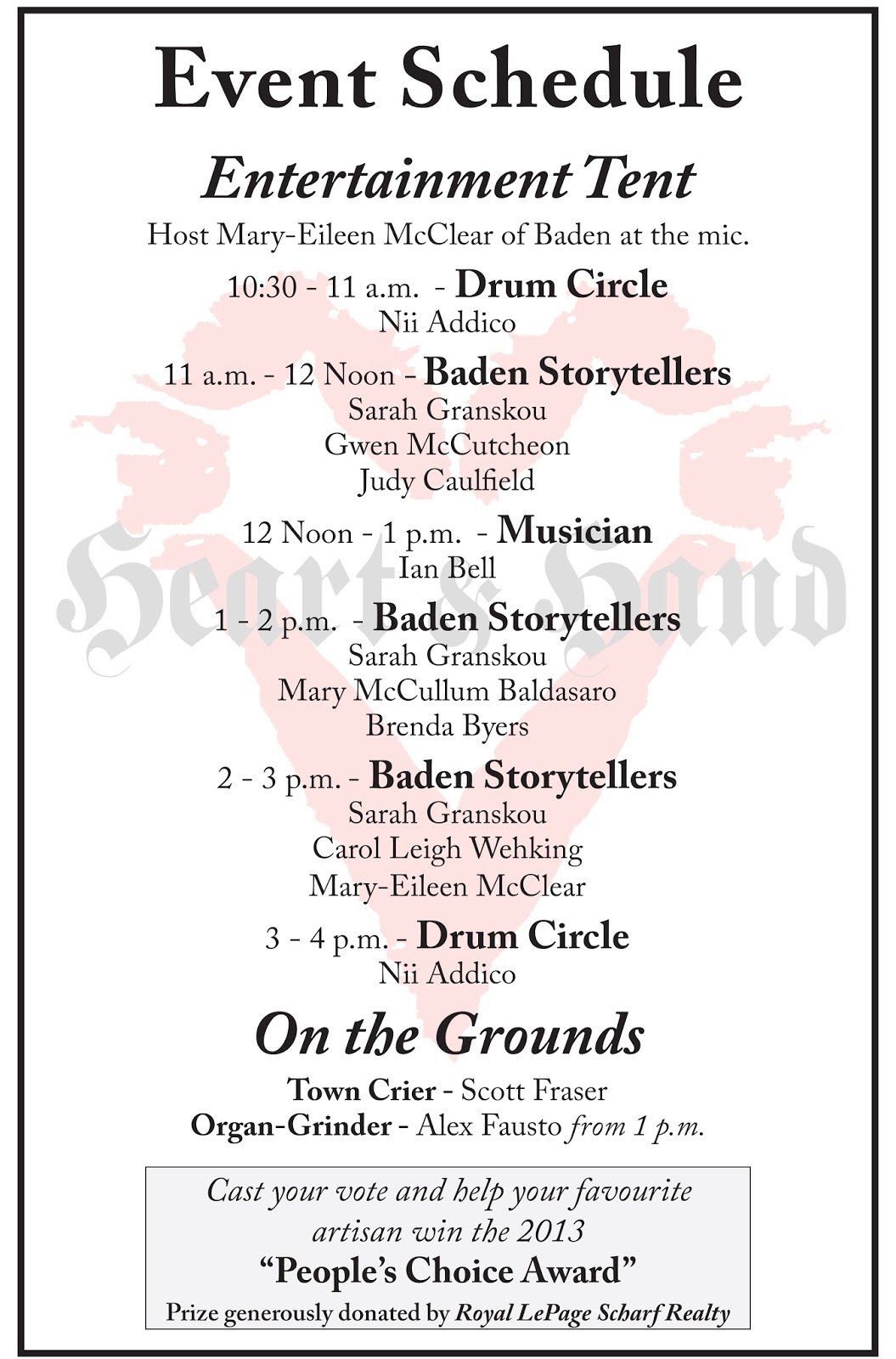
Heart & Hand: Event Schedule!

Mary-Eileen McClear, founder of the Baden Storytellers
entertaining at last years Heart & Hand Festival.
We are very pleased to welcome members of the Baden Storytellers Guild to entertain and inspire with their dynamic storytelling skills at this year's Heart & Hand Festival! 
Established in 1989 the Baden Storytellers Guild encourages individuals to hone and practice the traditional art of storytelling. Interested in finding out more or telling a story of your own? Join the guild for their Stories Aloud evening, an open mic night for adults held the second Friday of every month from September through June from 8 to 10:30 p.m at the Button Factory, 25 Regina St. South, Waterloo. Doors are at 7:30. The price is $5 and "lug a mug" for hot cider!Visit the Baden Storytellers Website for more information or to find out how you can become a member!
Join us for this year's drum circles!
The Baden Storytellers along with Master Drummer Nii Addico and musician Ian Bell will be entertaining under the tent. Below is a schedule of events to help you plan your day!


Monday, 16 September 2013

Heart & Hand: Lace Maker Pamela Glew

Pam at last year's Heart & Hand Festival 
We are very happy lace maker Pamela Glew will be joining us again this year for the Heart & Hand Festival. We asked Pam a few questions about her work, what it is about lace making that she most enjoys and how this art form will survive in the future.  
Pamela Nottingham Bobbin Lace making book

What was your first experience with lace? What initially drew you to this art form? 
From childhood, I was attracted to lace because of its translucent  and fairy-like qualities. I failed to get my grandmother to teach me her crochet lace skills, but taught myself shuttle tatting while in my teens.  In my twenties I discovered that I was the namesake of Pamela Nottingham, one of the pioneers of the UK lacemaking revival, and bought her book on bobbin lacemaking, but didn’t start lace classes for another ten years,  when I realized that “it was meant to be!
Needle lace (left) and
Carrickmacross, organdie applique on net (right)

Are there different types of lace? What is special about the type of lace you make?Depending on how it is defined, there are hundreds of types of lace, grouped for convenience by their method of construction. Some are made with a single continuous thread, looped as in knitting or crochet, or knotted as in tatting or filet. Others are based on embroidery stitches, either applied to woven fabric or net, as in Hardanger and  tambour, or built up from rows of buttonhole stitches, as in true needle lace. The bobbin or pillow laces are  woven or plaited from multiple threads, wound on stick-like bobbins and hanging from pins placed in the pattern supported by a tightly stuffed pillow. Further sub-groups contain laces which combine two or more of these techniques, such as Battenberg or Ayrshire work, and of course, nearly all these types can be imitated by machine-made versions that look good enough – to the uninitiated! I am mainly attracted to some of the bobbin laces, because of their versatility, but I would need several more lifetimes to try them all, and new laces are being invented all the time, by teachers and designers. I also enjoy “dabbling” in other types of lace, especially Lier/Tambour from Belgium, Carrickmacross from Ireland, English “Hollie Point”/needle lace and still, occasionally, tatting!


Is lace making a dying art form? How can we ensure that the tradition of lace making survives?
Lacemaking as an economic activity/industry has all but died out, to be replaced by  its role as a medium of artistic expression appropriate to our rapidly changing cultural scene. My interest in keeping it alive springs from my background in history, textiles and costume (for humans and dolls!) but I also like to explore new ways of using  the techniques with non-traditional  fibres, wire, beads etc. in contemporary designs and functions.
Lace making techniques used in new ways


There are indications that many of the coming generation are interested in History as a means of interpreting our future, and if this interest extends to discovering the skills of traditional crafts and employing them to create the cultural objects of the future, lacemaking should survive along with the more obviously “practical” trades. The role of electronic communication will be crucial to this survival, enabling fibre artists from across the world to exchange ideas on dedicated chat sites, international and local guild websites, through educational initiatives with how-to videos, online courses with links to live teachers, downloadable documents, patterns and suppliers’ catalogues for ordering previously obscure materials with a few mouse clicks! Aspiring younger lacemakers used to search out the aged practitioners, to make notes on the  fine points of the craft before it and they, passed away; now the next generation can go to the aged lacemaker’s website or watch her manipulate threads tirelessly on Youtube, but will also be made very welcome at the many live craft guild meetings, shows and demonstrations.  

Bobbin lace in progress
Do you have plans for any future projects? What is one thing you hope to achieve or piece you hope to make? 
I have ongoing projects to make a replica 19th c. Bedfordshire lace fall cap, to be worn with my historical interpreter’s costumes, and to make a full-size, rather than miniature fan leaf, to fit some antique bone fan sticks. 
Three dimensional lily as decorative hair piece
Having made modern, 3D lace lilies for my daughter-in-law’s bridal headpiece, I am now contemplating making something in lace for my first grandchild, a baby who will not need a christening gown, but who deserves something very special!


Three dimensional lilies made using traditional lace making techniques

Have some more questions or would like to see bobbin lace in the works? Come out to the Joseph Schneider Haus this Saturday, Sept. 21!

Thursday, 12 September 2013

Heart & Hand: Pysanky Artist Anne Cline


Decorated Ukrainian Eggs aren't just for Easter! Pysanky artist Anne Cline (Heart & Hand Best of Show Winner in 2012) is joined by her granddaughter as they explain the traditional meanings of Pysanky designs and demonstrate this unique art.

What do the different designs mean? How are they made? Where does this tradition come from? Watch this video and find out!

Visit Anne at the Heart and Hand Festival Saturday, September 21 as she demonstrates her traditional folk art. 


Tuesday, 10 September 2013

Heart & Hand: Ceramic Artist Rosemary Aicher


Ceramic artist Rosemary Aicher invites us into her pottery studio. Watch as Rosemary throws a bowl on the wheel. Learn a little about her technique and her unique style.

Rosemary will be at the Joseph Schneider Haus Saturday, September 21 for the Heart & Hand Festival. She will be demonstrating throwing on the wheel and giving you a chance to try your hand!


Thursday, 5 September 2013

Heart & Hand: Origami Tulip

The Heart & Hand flyer is really a tulip... an origami tulip that is! Get your copy today or follow this instructional video and learn how to make your very own. Summer is winding down but you can create a little bit of spring with this craft.

Join us Saturday, September 21 at the Joseph Schneider Haus for hands-on activities, stories, music and much more!

Tuesday, 25 September 2012

Heart & Hand: The Award goes to...

Thanks to all the artisans, volunteers and those of you who came out and took part in Saturday's event! The weather cooperated (for the most part) and we had a great turn out. Many of you who visited voted for the "People's Choice Award" which went to....

Sandra Dunn and Stephen White - "Two Smiths"
Sandra Dunn and Stephen White
- the "Two Smiths" (Kitchener)
They delighted and impressed audiences with the intricate details they were able to create through heating and hammering copper and iron.


Anne Cline - Pysanky Artist


Our “Best of Show” was awarded by our panel of judges, Rosemary Aicher, Linda Crawford and Stephanie Walker.

Anne Cline with her intricate and delicate traditional pysanky art “Ukranian Easter Eggs” was awarded the prize for 2012.


Congratulations to our winners and a special thanks to Royal LePage Scharf Realty for generously donating the prize.

We look forward to seeing you all next year!